

Gardening is an increasingly popular hobby, which is also attracting the interest of those who live in the city: a trend accelerated by the pandemic and which sees increasingly younger followers among its followers.
Sensitivity towards organic and eco-sustainability, the choice of fresh vegetables free from harmful chemicals, in addition to a proven anti-stress effect , are the motivations that push people to approach this activity.
You can take advantage of the space you have: whether it is a large or small plot of land or a few pots on the balcony.
Before starting, in addition to having some basic knowledge about the type of soil, exposure to sunlight or the choice of the most suitable plants, it is necessary to equip yourself with the right tools to work the land.
The soil preparation phase, which precedes sowing or transplanting , is in fact fundamental to achieving good results.
In this article you will learn what are the fundamental tools to work the land in the right way. The good news is that for medium-small lands you will not have to spend a fortune: you will only need a few simple tools , the same ones that our grandparents used.
When choosing tools, it is good practice to consider their handling, based on your skills and strength . This way, you can work more comfortably and reduce the risk of injury.
Here are the topics we will explore in this article :
- 3 Essential Tools for Working the Land
- Small hand tools for growing vegetables in pots on the balcony
- Working the land with children: which tools to choose?
- Watering the garden while saving water is possible!
- How to care for and protect the vegetable garden?
- How to choose the best tools for working the land?

The 3 essential tools for working the land
There are various tools available on the market for working the land, but there are 3 that absolutely cannot be missing .
In fact, each one will be indispensable for each specific phase of soil preparation, that is: the spade, the hoe and the rake.

1. The spade: it loosens the soil deeply and eliminates the roots
The spade is an essential tool for working the land and making it ready to host your vegetable garden.
What do you do with the spade?
Digging is used to work the soil deeply, thus eliminating weeds and any roots that may have survived from old crops .
With this tool you will break the soil into clods that you will leave exposed to winter frosts.
In the spade the steel blade is sunk for about 20-30 cm and turned to create the clod . After this operation the soil will be softer.
Before you begin, make sure the soil is not too wet . To do this, simply turn over the first clod and see if the blade is dirty with mud or not.
The spade is similar to the shovel but with the difference that, to sink it, you use the force of your foot by pressing on the appropriate bracket.
When choosing the shape of the spade that best suits your needs, take into account the characteristics of your soil: the pointed one , penetrating the soil more easily, is more suitable if the soil is harder and more difficult to work. On the contrary, you can also opt for a square shape .
Pay attention to the handle which must be:
- Of a length proportionate to your height , to avoid getting back pain
- Made of sturdy material, preferably wood
Similar to the spade, the shovel , or shovel, can be used to move earth and spread fertilizer.

2. The hoe: the oldest multifunctional tool for working the land
Hoeing is the work phase that is carried out at the end of winter to prepare the soil for sowing. This operation serves to break up the clods created by digging and make the 10/20 cm of surface layer finer and softer .
At this stage, the previously spread fertilizer is also incorporated into the soil.
The hoe, however, has many other functions . It is no coincidence that this tool is one of the oldest and a true symbol of the peasant world, so much so that it is the protagonist of popular sayings and proverbs such as "On the plain or in the mountains without a hoe you can't eat".
The hoe is also used for:
- Break the roots of weeds and then remove them
- Digging channels for rainwater drainage
- Earthing up the plants , that is, moving a little soil at the base of the plant, creating a small mound to protect the crop
- Marking furrows for sowing or transplanting
- Hoe around the plants to break the surface crust that often forms on the soil, thus allowing it to oxygenate.
Generally, the hoe has a metal blade and a wooden handle, just like those of a hundred years ago.

The traditional one is composed of a single blade that can have more pointed or more squared shapes depending on the type of more or less hard and heavy soil that will be worked. An excellent alternative, in terms of functionality, is the double-pronged hoe.
The two-pronged hoe ends with two different tools: on one side you will have the straight blade of the classic hoe and on the other a fork (the two-pronged hoe).
This type of hoe is truly multifunctional and allows you to create furrows, aerate the soil and weed.
Even in this case, the length of the handle (usually 70/80 cm) and the weight of the tool must be chosen based on the characteristics of the user.
The inclination that you give your hoe to hit the ground will be different depending on the operation that you are carrying out, whether it is turning the clods or breaking the roots etc...
As always, the rule that experience teaches applies, so if at the beginning it seems more complicated, as you get the hang of it, everything will be simpler and faster, although still tiring!

3. The rake: cleans and levels the ground
It is the third essential tool for working the land.
Its functions, as far as vegetable gardening is concerned, are multiple:
- Clean the soil from roots (cut in the previous processing phases) and stones
- Level the surface in preparation for sowing or transplanting . A well-leveled soil is essential for a successful vegetable garden.
- Incorporate the fertilizer
- Bury the seeds
How to choose a rake?
The choice of the type of rake, especially with regard to the number of teeth, more or less dense, depends on the use that is to be made of it:
- For harvesting (for example leaves) it has wider teeth
- To level the ground , prepare the seedbed, lightly bury the seeds and turn the compost, you will need to opt for a tool with thicker teeth and a not too long handle.
All the tools for working the land seen so far, the handle , being continuously stressed, is the part most subject to breakage . Don't worry: you can only buy the handles for replacement tools for your spade, your hoe or your rake.

Small hand tools for growing vegetables in pots on the balcony
To take close care of each vegetable and especially if you grow the garden in pots on the balcony you will need small tools to work the soil , many of which, due to their type of function, are miniature copies of their larger equivalents.
- Hoes , also available in double-pronged versions
- Palettes of various shapes, the smaller "sisters" of the spade
- Rakes , for cleaning and leveling around the seedlings
- Weeders and hoes are used to eliminate weeds more easily.
- Planter , useful for making small holes in the ground for sowing or planting seedlings
- Scissors and wire cutters are useful for pruning plants and harvesting vegetables

Working the land with children: which tools to choose?
Growing a vegetable garden can be a really fun and educational activity, even for children.
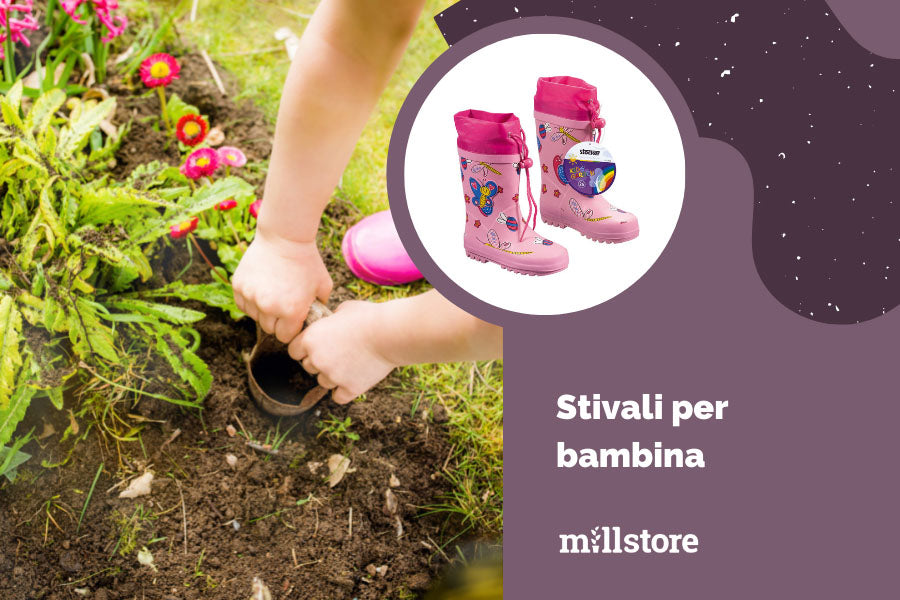
To involve them and make them feel truly useful, at Millstore you can find, at a very affordable cost, a wide range of tools and clothing for children , just like those of adults but, in terms of materials, colours and dimensions, tailor-made for the little ones .
Cute little hoes, rakes, shovels, buckets, wheelbarrows, watering cans and tool belts complete with all the essential utensils will make your children feel like perfect little gardeners .
Raincoats and colorful ankle boots will allow them to help you even in the coldest periods.
A tip for adults: don't forget to use work gloves (different types of material) suitable for the task you are doing for yourself and your children . They are essential for safe farming.
Watering the garden while saving water is possible!
Water is a fundamental element to obtain good results in vegetable gardening. For this reason , choosing the irrigation tools that best suit the needs of your vegetable garden and the time you have available for watering is essential .
Remember that there should be neither too little nor too much water (to avoid stagnation that would damage the plants) but in the right quantity with respect to the climatic conditions and the varieties of vegetables you grow .
The choice of irrigation type will depend on the size of your garden and the time you have available to dedicate to it . The important thing is not to leave the crops without water, especially in the driest periods.
If your garden is small or if you grow on a balcony, a simple and inexpensive watering can will suffice . Alternatively, you can use hoses to which you can attach lances or guns if you wish.
If you want to save precious drinking water, a rainwater collection tank may be the solution for you. You will have clean water for your plants at no cost.
If, however, you are unable to guarantee regularity in the frequency of irrigation and you prefer a more practical and automated system without spending a fortune , you can opt for a drip irrigation system , also called micro-irrigation.
This method delivers water to plants slowly and without waste and can be customized to suit the characteristics of your garden.
The use of control units and programmers is essential to ensure that your vegetables have their water needs covered if you have to be away for longer or shorter periods.
Here are the advantages of drip irrigation :
- Water saving , not only good for your wallet but also for the environment
- Better irrigation , because the water slowly flows from the surface to the roots
- Helps prevent fungal diseases by avoiding moisture in the stems and leaves of plants
- You save time because the system, once set up, will do it by itself
- You can schedule irrigation and ensure your crops get the water they need even when you are on vacation.
This practical system can also be applied to the balcony garden.
At Millstore you can find complete micro-irrigation kits suitable for flowerbeds, vegetable gardens and vases .

How to care for and protect the vegetable garden?
In addition to tools for working the soil, your vegetable garden will need other tools to provide you with a good harvest, such as stakes and plant supports , necessary for supporting certain types of crops, and mulching materials.
If you want to know the methods to take care of your garden, read the article “ How to grow and take care of an organic garden ”.
Supports and plant supports: to support plants
Some types of vegetables have thin stems and risk falling under the weight of the fruit . The classic example is the tomato.
It is then necessary to intervene with supports and plant supports such as bamboo canes on which you will tie the plant in order to allow it to develop in height.

Mulching: what is it and what is it for?
Mulching is a very important technique for protecting the vegetable garden and consists of covering the soil around the plants to prevent weeds from growing due to both the lack of sunlight and the necessary space.
For mulching you can use materials such as straw, dry leaves, bark, waste plant materials (therefore at zero cost) or mulching mats such as biodegradable sheets or jute or coconut fiber discs which are very simple to apply.
This technique, essential if you grow organically, is very useful because it guarantees the most superficial part of the roots a milder temperature in the colder months while, in the warmer ones, it reduces the need for watering .

How to choose the best tools for working the land?
As you may have already understood, to grow a vegetable garden you really only need a few simple tools. To get started, start with the essential tools we have talked about .
Along the way, as you gain experience, you will realize what could be useful to you in addition and you can learn more by reading the article " Complete guide to the essential tools for growing vegetables and gardens ".
The same can also be said for irrigation: if you have a small vegetable garden or some pots on the balcony, start with a watering can and hoses and then, if necessary, move on to a micro-irrigation system.
If you are a beginner, ask your trusted dealer for advice, who will be able to tell you the type of tool that is best for you. Whether you want to buy directly in the store or online, Millstore will support you in choosing the right tools for your needs .
A team of experts will be at your disposal by phone, email, on the site chat and on social channels.