How to Grow White Asparagus
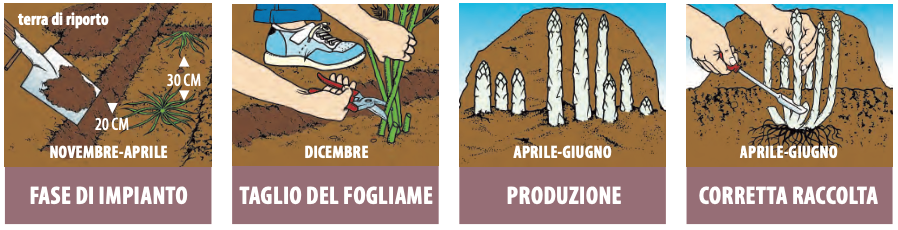
It prefers loose or light soils without a stony texture. Prepare a furrow in the shape of an inverted trapezoid, 15-20 cm deep, 30 cm wide at the base, and 40-50 cm wide at the top, well fertilized with organic matter. The optimal transplanting time is from November to April. The crowns should be placed in a single row at the bottom of the furrow, spaced 30 cm apart (3 crowns per linear meter), taking care to spread the roots horizontally and cover them immediately with 5 cm of soil. The distance between rows varies from 150 to 200 cm. In the 1st year of planting, the furrow is progressively covered as the vegetation grows, reaching ground level by the end of the year.
In the second year (early spring), an additional 20-30 cm of soil must be mounded onto the asparagus bed. A ridge will form, which is essential for the correct growth of white asparagus, which requires a light-free environment for its optimal development. To also have white asparagus tips, the asparagus bed can be covered with black polyethylene. After harvesting (late spring), remove the mound of soil and return the ground level to horizontal. It will be covered again the following year as soon as the first asparagus spears emerge. For summer and autumn cultivation, proceed as for green asparagus (see above). White asparagus has a much more delicate and less pronounced flavor than green asparagus. It is highly appreciated because, having less fiber than green, it is entirely edible.
In spring, with the rise in temperature, the buds begin to develop, forming shoots that emerge from the ground. When their height is satisfactory, before the tip opens, the asparagus can be harvested. It is important to cut the asparagus below ground level. Harvesting normally lasts for about 60-70 days, after which it is advisable to stop harvesting to revitalize the plant. Unharvested spears grow in height, open their tips, and form foliage. The aerial part, which reaches up to 1.5 m in height in adulthood, begins to process the useful substances absorbed from the soil. During this phase (summer), it is important to fertilize, especially with nitrogen. In late autumn, the foliage begins to yellow, and when it is completely dry, it should be cut flush with the ground and removed. After this operation, abundant organic fertilization and possible hilling are recommended to optimally cover the productive cordon.