10 Legs Wild Asparagus Bitter Montina - L'Ortolano
10 Legs Wild Asparagus Bitter Montina - L'Ortolano is backordered and will ship as soon as it is back in stock.
Description
Description
Asparagus legs ready to plant Wild Amaro Montina variety.
This delicious asparagus is characterized by having thinner shoots compared to other more well-known types. Its peculiarity is the pleasant and persistent bitter sensation that we also find in other vegetables such as chicory and artichokes; this sensation is contrasted with a medium sweet tendency, suffi cient to enhance the sensory characteristics of this very interesting product, together with the savory/mineral hints that are always present and often lead us back to sulphurous and salty aromas.
To be paired with all gastronomic preparations with a good sweet tendency, possibly enriched with extra virgin olive oil with a ripe and intense fruitiness.
The package contains 10 paws.
How to grow Wild Asparagus Amaro Montina:
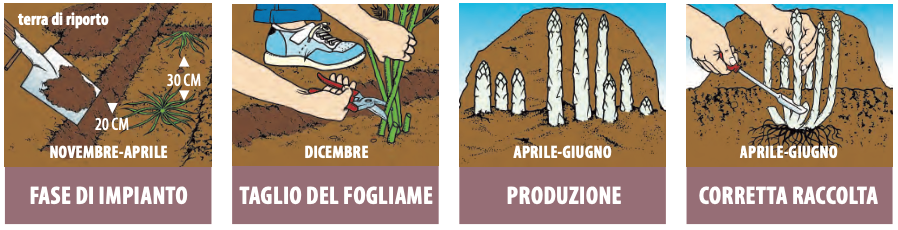
Prepare a furrow in the shape of an inverted trapezium, 15-20 cm deep, 30 cm wide at the base and 40 cm at the top, well drained and well fertilized with organic matter. The optimal time for transplanting is from November to April. The legs must be arranged in a single row on the bottom of the furrow and spaced 30 cm apart (3 legs per linear meter), taking care to spread the roots well horizontally and cover them immediately with 5 cm of soil. The distance between the rows varies from 100 to 120 cm. At the end of the 1st year of planting, cover with another 5 cm; a harvest of 2-3 asparagus per plant is recommended (this helps the asparagus bed to strengthen). Once the harvest is over (late spring-early summer), allow the foliage to develop and fertilize during the summer, with nitrogen and potassium fertilizers. In autumn, when the foliage is yellow, cut it to the same level as the ground and fertilize with mature manure or similar. During cultivation, keep the asparagus bed clean of weeds. The cleaning hoeing must be very superficial. Irrigate during dry periods.

10 Legs Wild Asparagus Bitter Montina - L'Ortolano is backordered and will ship as soon as it is back in stock.